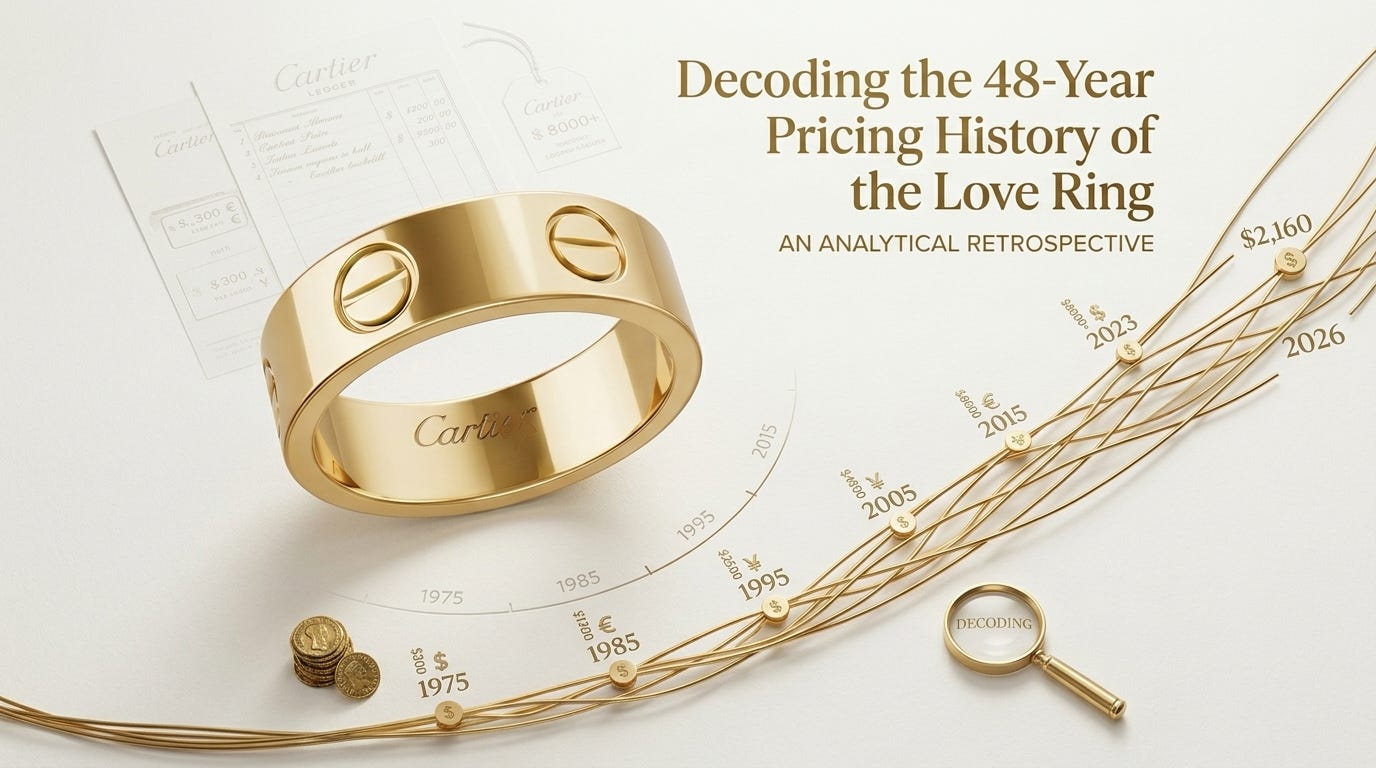
Decoding the 48-Year Pricing Strategy of the Cartier Love Ring
An analysis...
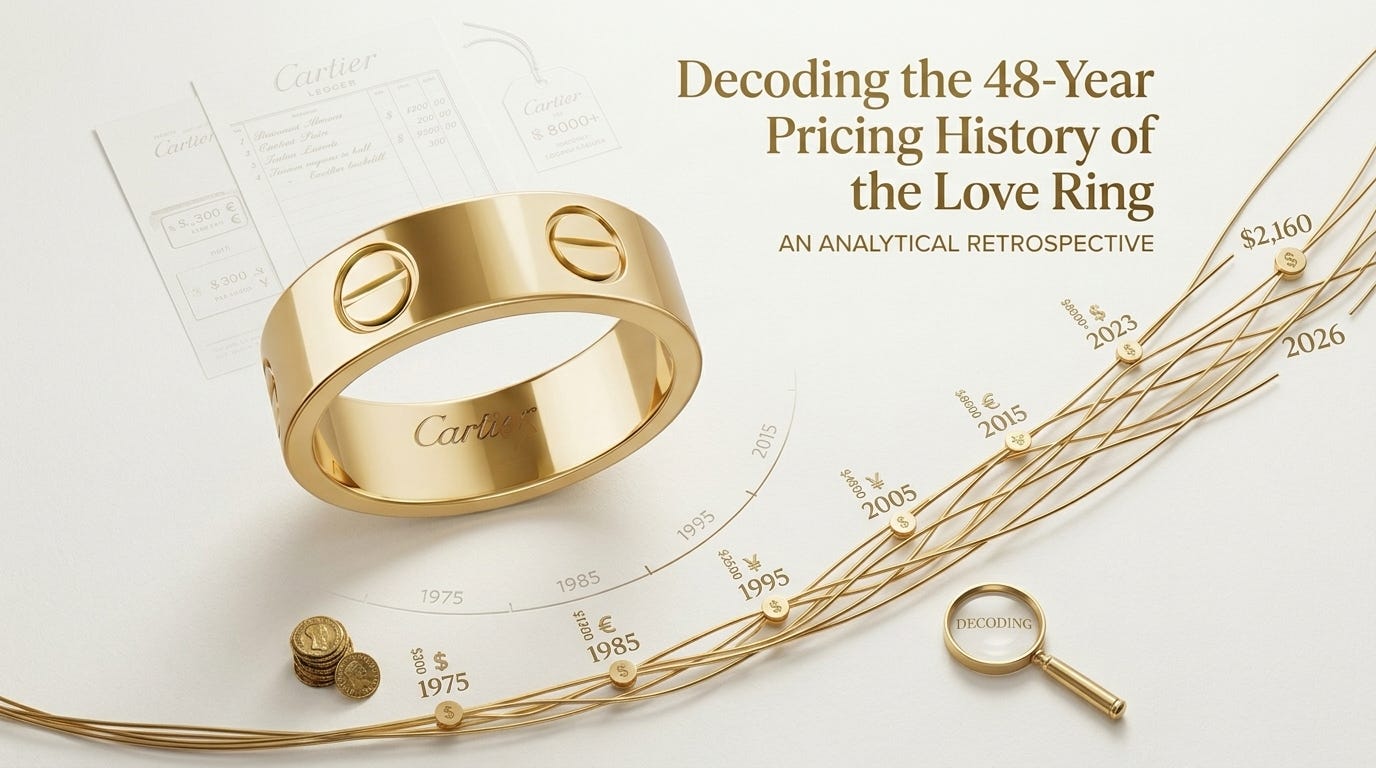
When Aldo Cipullo created the Cartier Love Bracelet in 1969, he fundamentally changed how the world interacted with fine jewelry.
It was no longer reserved for special occasions; it was meant to be bolted onto the wrist and lived in. Nine years later, in 1978, the Classic Cartier Love Ring was introduced to the collection to capitalize on the bracelet’s global success. Debuting at a modest $150, it quickly cemented itself as a definitive global status symbol.
I. The Genesis of the Flat Price
Heritage luxury houses fiercely protect their corporate data, but historical records tell an undeniable story. When the standard Love Ring officially debuted in 1978, it retailed for exactly $150. Back then, global raw gold was hovering around $208 per troy ounce.
Cartier instituted a tradition that heritage luxury houses fiercely defend to this day: the “flat-pricing” model.
Whether you bought the smallest available size or the largest, the price tag was exactly the same. In 1978, maintaining a flat price was simple. The pure 18K gold melt value of a standard Size 52 Love Ring (roughly 7.2 grams) was just $36. The $150 price tag represented an easy, sustainable ~4.1x markup over raw materials. The extra gold needed for a larger ring was a rounding error. But as the decades progressed, Cartier’s pricing strategy shifted from a reasonable materials-based calculation to a purely aspirational luxury markup.
II. The “Upward Ratchet” Strategy
To understand legacy luxury pricing, you only need to observe the historical data. Heritage houses operate on a strategy we can call the “Upward Ratchet.” When macroeconomic forces or supply chain issues push raw material costs up, the retail price hikes up with them. But when gold prices fall, the retail price never comes down.
The most revealing era of Cartier’s pricing strategy occurred between 2012 and 2015. In 2012, global gold prices soared to $1,664 per ounce, and Cartier priced the Love Ring at $1,380. But over the next three years, the raw price of gold plummeted, dropping to $1,060 per ounce by 2015. Did the retail price of the Cartier Love Ring drop to reflect the cheaper materials? No.
In fact, Cartier raised the retail price to $1,650, establishing a firm “plateau” to train aspirational buyers to accept a new baseline. During this 2015 era, Cartier was pulling an astronomical ~9x markup on the pure metal value of the ring.
III. The Volumetric Pain Point
Here is where the legacy pricing model starts to buckle under the weight of the modern era. A standard classic Love ring has fixed cross-section dimensions (roughly 5.5mm wide by 1.5mm thick). Because the cross-section remains static, the amount of extra 18K gold required is dictated entirely by the inner circumference of the ring.
For every 1-millimeter increase in circumference, the ring requires an additional 8.25 cubic millimeters of volume, or about 0.128 grams of 18K gold. Since the gaps between a size 44, a size 58, and a size 72 are exactly 14mm jumps, the volumetric weight differs drastically:
Size 44 to 58: A Size 58 requires approximately 1.79 extra grams of 18K gold compared to a Size 44.
Size 44 to 72: Moving from the smallest extreme (44) to the largest extreme (72) adds almost 3.6 extra grams of solid 18K gold.
To put that into perspective, an average Size 52 classic Love ring weighs roughly 7.2 grams. Moving from a Size 44 to a Size 72 represents a nearly 50% increase in the total amount of gold used.
IV. The Flat Price Conundrum
When gold was cheap, giving away 50% more gold on a larger ring was an easy corporate decision. In 1978, the raw 18K gold cost difference between a Size 44 and a Size 72 was a mere $18.
But today, with post-pandemic inflation and extreme run-ups in the spot market pushing gold past $2,600 in 2024 and pacing toward an estimated $4,322 by 2025/2026, the math fundamentally breaks. At a projected $4,322 per troy ounce:
The pure gold cost for a Size 44 is approximately $643.
The pure gold cost for a Size 72 is roughly $1,017.
That is an astonishing $374 difference in material costs for the exact same SKU.
This creates immense pain points for Cartier and other legacy retailers. Because they refuse to price by volume, they are trapped. To cover the heavy material margin losses they take on larger sizes, they are forced to continually inflict massive structural price hikes on everyone. It is why the classic band was recently pushed well past the $2,000 barrier toward an estimated current/projected $2,550. Under flat pricing, the customer buying the petite Size 44 is mathematically subsidizing the $374 of extra gold on the Size 72.
Alternatively, to save their margins, heritage brands simply stop offering larger sizes altogether.
How do you solve a nearly 50-year-old pricing trap? By abandoning the flat-price illusion and embracing an algorithmic model based entirely on exact volume and live metal markets.
V. What Transparent Pricing Actually Looks Like
Now here is where it gets interesting. Because once you can see the math, you can ask a different question: what would it cost to buy a band of equivalent gold weight, equivalent finish, in any size between 2.5 and 17.5 in quarter-size increments, made on demand in the United States, with no markup for unsold inventory?
That is exactly what THEFUTUREOFJEWELRY’s volumetric pricing algorithm calculates, in real time, for every band on our platform. The algorithm takes two concrete inputs and returns a price that updates as the customer adjusts their design:
The live daily spot price of the chosen precious metal—sterling silver, 14K gold in yellow, white, or rose.
The exact 3D material volume of the customer’s specific design—calculated from the actual geometry of the band at their actual size.
A 6mm wide band uses more metal than a 3mm wide band, and it costs more. A size 13 ring uses more metal than a size 5, and it costs more. The customer watches the price update on screen as they change those parameters. Nothing is hidden. Nothing is inferred.
This is what ‘transparent pricing’ actually means. It does not mean a printed price tag in a glass case. It means the customer can see the input variables, watch them change, and verify the math against the live commodities market.
Try it yourself, right now, in your phone’s browser: → Design a custom wedding band at THEFUTUREOFJEWELRY.com/bands → Design a custom signet ring at THEFUTUREOFJEWELRY.com/signets
VI. The Inclusive Sizing Dilemma
There is one more thing worth noting about the Cartier Love wedding band, and it connects directly back to Issue No. 2 of this Substack. The Cartier Love wedding band is currently produced in sizes from approximately 44mm (US 3) to 72mm (US 13.75), in roughly half-size increments.
That is a wider range than most legacy retailers offer, and Cartier should be credited for it.
But it still excludes:
■ Anyone who needs a smaller-than-US-3 ring (children’s signet bands, very petite hands, certain medical conditions that affect finger size).
■ Anyone who needs a larger-than-US-13.75 ring—a population that includes a meaningful number of adult men, particularly those with larger hands or specific occupations.
■ Anyone whose actual finger size falls between two of Cartier’s offered sizes—quarter sizes, which Cartier does not produce.
THEFUTUREOFJEWELRY’s platform offers US sizes 2.5 through 17.5, in quarter-size increments, because we generate the 3D file algorithmically at the moment of order—not from a fixed inventory of pre-cast molds. The same volumetric algorithm that calculates your live price is what calculates your exact ring geometry. There is no warehouse of pre-made size 7s and size 9s gathering dust until they are picked. Every ring is generated for the specific person ordering it.
This is, in a real sense, the restoration of the artisanal Standard-of-One we wrote about in Issue No. 2—but at a price point and a speed that the artisanal era could never deliver.
VII. So What Should You Actually Do?
If you want a Cartier Love wedding band, buy a Cartier Love wedding band. It is a beautiful, well-made object designed by one of the most important jewelers of the 20th century. There are good reasons people want one. The screwdriver-and-screws motif is genuinely iconic. The red box is genuinely lovely. Cipullo’s place in design history is genuinely earned.
But buy it knowing what you are buying. You are paying approximately $1,000 over the fully-loaded cost of production for the Cartier name, the boutique, the heritage, and the design IP. That is a legitimate purchase. It is just a different purchase than most people realize they are making.
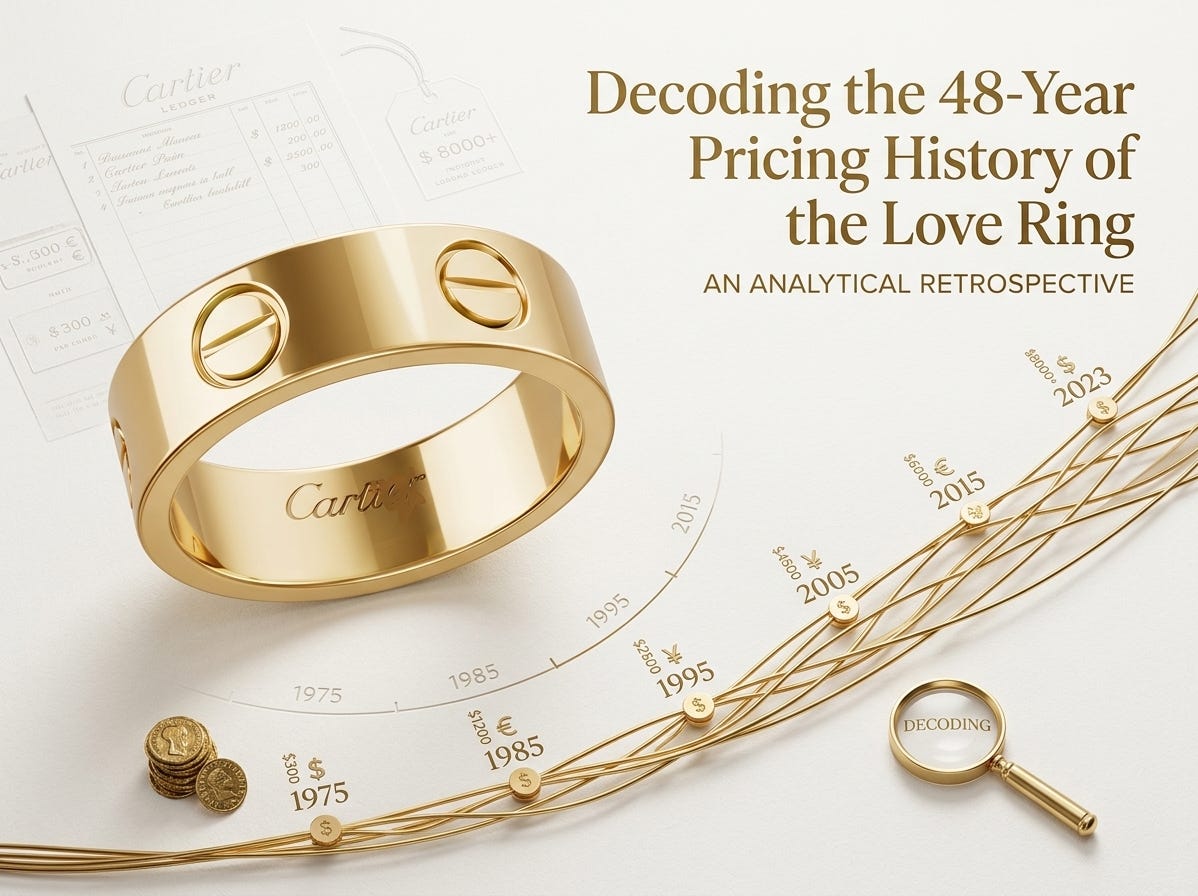
And if you want something else—if you want a band of equivalent or greater gold weight, made to your exact size in quarter-size increments anywhere from 2.5 to 17.5, with a design you authored yourself, priced in real time against the live spot market, made on demand by U.S. casting partners using the same lost-wax process Cartier uses, with the math shown to you on screen as you design it—that option exists now. It did not exist in 1978
.